
-
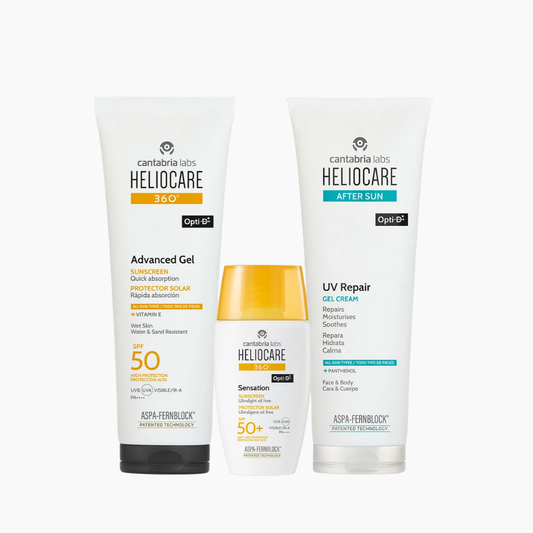
Heliocare After Sun UV Repair Gel Cream
Vendor:HeliocareRegular price £20.00Regular priceUnit price per -
Heliocare Face & Body Kit
Vendor:HeliocareRegular price £59.99Regular priceUnit price per -
Environ RAD Antioxidant SPF 15 Best Seller Twin Set
Vendor:EnvironRegular price £45.00Regular priceUnit price per



Frequently Asked Questions
What SPF should I use every day?
The NHS recommends sunscreen with at least SPF 30, used alongside shade and protective clothing. Choose broad-spectrum UVA and UVB protection. Higher SPF can provide a greater margin when applied correctly, but no sunscreen gives complete protection.
How much sunscreen should I apply to my face?
Apply a generous, even layer to the face, ears and neck according to the product directions. A thin cosmetic layer may not deliver the labelled protection. Reapply during exposure and after swimming, sweating or towelling.
Is SPF 50 much better than SPF 30?
Both can provide high protection when applied correctly. SPF 50 filters more UVB than SPF 30 under test conditions, but application amount, missed areas and reapplication strongly affect real-world protection. Choose a broad-spectrum formula you will use generously.
Do I need sunscreen in the UK or on cloudy days?
UV can reach skin even when the weather feels cool or cloudy. Daily facial sunscreen is particularly useful when spending time outdoors, using photosensitising skincare or managing pigmentation. Check the UV index and use shade and clothing as well.
What is the difference between mineral and chemical sunscreen?
Mineral sunscreens use filters such as zinc oxide or titanium dioxide; other sunscreens use organic UV filters, and some formulas combine types. Both can provide effective protection when properly formulated and used. Choose based on verified UVA/UVB protection, texture, and tolerance.
Can make-up or moisturiser with SPF replace sunscreen?
Only if enough is applied evenly and reapplied as required, which is uncommon with make-up. A dedicated sunscreen makes adequate application easier. Treat SPF make-up as an additional layer rather than the only protection during meaningful exposure.
Do oral sun supplements replace sunscreen?
No. Supplements do not replace topical broad-spectrum sunscreen, shade, clothing or a hat. They must not be marketed as preventing sunburn or making prolonged exposure safe. Follow the supplement label and check suitability with a healthcare professional.
Notes On Skincare
-

Fernblock®: the ingredient that makes Heliocare...
What is Fernblock® and why does it matter? A deep dive into the fern extract behind Heliocare 360°, the science, and why it's a genuine differentiator.
Fernblock®: the ingredient that makes Heliocare...
What is Fernblock® and why does it matter? A deep dive into the fern extract behind Heliocare 360°, the science, and why it's a genuine differentiator.
-

Heliocare 360°: Which SPF Is Right For Your Ski...
Our Heliocare 360° review breaks down every SPF50 formula by skin type, compares 360° vs Advanced, and helps you find your perfect match.
Heliocare 360°: Which SPF Is Right For Your Ski...
Our Heliocare 360° review breaks down every SPF50 formula by skin type, compares 360° vs Advanced, and helps you find your perfect match.
-

Why Perimenopause Can Feel Like a Second Adoles...
Breakouts and fine lines at the same time?! The wonderful world of perimenopause.
Why Perimenopause Can Feel Like a Second Adoles...
Breakouts and fine lines at the same time?! The wonderful world of perimenopause.


Let customers speak for us

Very good

Love this skincare have been using it for years!

Excellent product which I have been using for years

Excellent products which enhance the quality and appearance of the skin

Been using AVST moisturiser for couple years now vombined with AVSTSupet moisturiser plus and such a Difference it has made to my
once sensitive reactive skin

Have used for years and will continue using

Have used for years and would not give up using however

I use all Jane Iredale products the blusher is gorgeous like all of her products good for sensitive skin goes on smoothly.

Love this eye shadow goes on smoothly lovely colours ,good for my sensitive eyes like all Jane Iredale products.

Great suppliments and so easy to use

Great for softening lines around eyes

Makes skin a lot clearer of pigmentation

So easy to apply a smooth line with this pencil. I have tried propelling eye liner pencils but they break so easily.

I have used this primer for some time now and wouldn’t use any other. Makes putting make up on so much easier.

You can really fell the difference straight away from using this product. It leaves your skin feeling clean, clear and soft.